
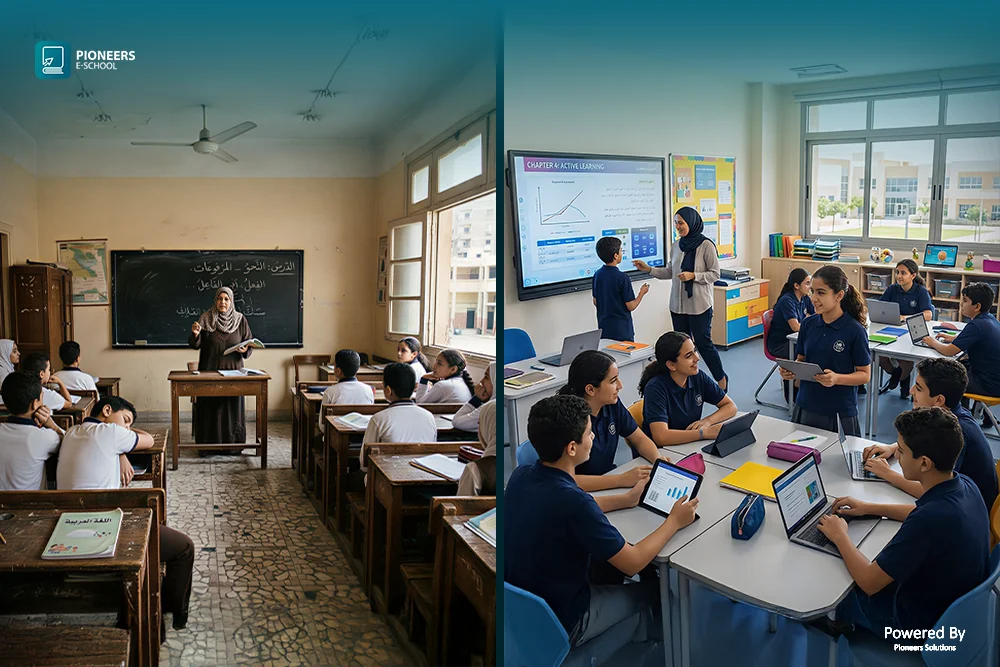
Smart Classroom vs Traditional
The Key Differences and Why Schools Are Moving to Smart Classrooms.
Many schools think using a smart board means they have a smart classroom. That is not true. The real change is not in the tools. It is in how teaching and learning happen. Ask yourself:
Has your teaching method changed, or just the tools?
Key Differences Between Traditional and Smart
Traditional Classroom
Teacher’s Role
- Main source of information
- Focus on explaining and lecturing
Student’s Role
- Passive listener
- Depends on memorization
Assessment Method
- Paper-based exams
- Periodic evaluation
Tools Used
- Whiteboard, printed books, pens
- Manual tracking systems
Smart Classroom
Teacher’s Role
- Facilitator who guides and supports
- Helps students discover answers
Student’s Role
- Active participant
- Engages, explores, and interacts
Assessment Method
- Online quizzes & projects
- Continuous assessment
Tools Used
- Tablets, interactive screens
- Learning platforms (LMS)
Why Are Schools Moving to Smart Classrooms?
Traditional methods no longer meet current expectations. Schools need to provide a more engaging learning experience.
How Do Smart Classrooms Improve Learning?
Smart classrooms make students an active part of the process.
This helps close the gap between teaching and understanding!
Is Your School Ready for This Shift?
Moving to a smart classroom is not just about buying devices. It requires a significant shift in how your school operates on a daily basis.
Practical Guide: Turn Your School into a Smart School in 5 Steps
Assess Your Current Situation
Ask: What are your current challenges? Is the issue engagement or management?
Set clear goals: Improve student interaction or reduce administrative errors.
Build the Right Infrastructure
Start with the basics: Strong internet connection, reliable internal network, and suitable devices. Without this, the entire system will struggle.
Choose an Integrated System
Avoid using separate tools. Use one system that manages: Students, Schedules, Attendance, Exams and grades, and E-learning. Such as Pioneers E-School.
Train Your Team
Technology alone is not enough. Focus on: Training teachers, training administrative staff, and explaining how to use the system properly. Better training leads to better results.
Start Gradually and Improve
Do not implement everything at once. Start with one grade level or one subject. Then expand based on results. Listen to feedback and improve continuously.
Turn Your Classrooms into Interactive Spaces
With Pioneers E-School, you can:
- Manage your entire school system
- Track student performance easily
- Improve communication with parents
- Apply smart learning practically
 share:


Related Articles
2026-05-07
Mohamed Abdelsalam
How Pioneers E-School Supports Smart Learning in Schools
Article Summary: The Problem: Using separate, disconnected apps leads to fragmented data, poor monitoring, and wasted administr...
2026-10-12
Mohamed Abdelsalam
School ERP Prices in Saudi Arabia 2026
A practical guide for private and international schools in Saudi Arabia to understand what determines school ERP costs, compare ready-made a...