
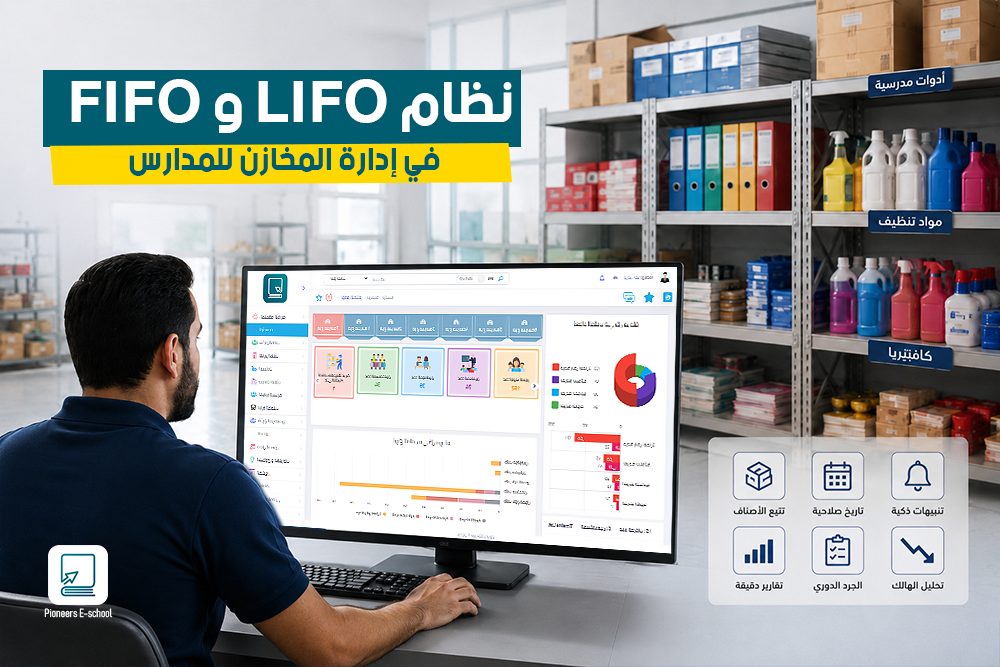
Article Summary (Smart School Inventory Management):
- The Problem: Manual school inventory management leads to supply wastage, cafeteria food spoilage, difficult financial auditing, and redundant purchasing.
- The Solution: Applying international inventory valuation systems: FIFO (First In, First Out) and LIFO (Last In, First Out) to control costs and shelf lives.
- Digital Facilitation: The integrated inventory module in the Pioneers E-School system automates these accounting methods and connects them with all school departments.
- The Result: Significant waste reduction, error-free periodic audits, and accurate valuation of school assets to safeguard the budget.
Understanding FIFO and LIFO in School Inventory Management
Your comprehensive guide to controlling school inventory, reducing waste, and automating finances
School inventory management is no longer just about manually cataloging chalk boxes or tracking basic classroom supplies. Today, modern educational institutions rely heavily on smart software ecosystems to structure stock movements, coordinate purchases, track assets, and tie inventory directly to general accounts — ensuring that the foundation of successful school management is solid and highly efficient.
Managing stock and supplies in schools plays an essential role in keeping expenditures in check and securing capital assets. To value inventory and direct store flows correctly, two primary valuation strategies are recognized globally: FIFO and LIFO.
Applying these modern systems directly benefits school administrations by:
- Minimizing supply wastage and avoiding spoilage of perishable goods.
- Enforcing strict shelf-life control for medical clinic and cafeteria supplies.
- Valuing remaining and consumed school inventory in real time.
- Tracking custody (عهد) and school assets with high precision.
- Optimizing procurement decisions and preventing duplicate or excessive orders.
The dedicated Inventory Management module within the Pioneers E-School platform fully automates these methods, offering an easy-to-use interface tailored specifically for private, international, and language schools.
What Is FIFO? (First In, First Out)
FIFO stands for First In, First Out. In simple terms, it means: The first items placed in stock are the first items to be issued or sold.
Under this valuation method, oldest inventory batches are consumed first. This approach is highly recommended and widely used in schools because it aligns naturally with physical store usage and prevents goods from sitting on shelves until they become obsolete or expire.
Practical School Example of FIFO:
Suppose the school purchases cleaning detergents in two separate batches:
Batch 1 (Older): 100 bottles at 50 EGP per bottle.
Batch 2 (Newer): 100 bottles at 70 EGP per bottle (due to inflation/market changes).
When the cleaning staff requests 100 bottles of detergent for classroom sanitization, the system automatically issues the items and calculates the cost based on Batch 1 (at 50 EGP per bottle). The remaining 100 bottles in stock are valued at the newer price of 70 EGP.
Why Do Leading Schools Rely on FIFO?
Schools hold massive quantities of seasonal and day-to-day materials that must be used in a logical chronological order to avoid financial losses. These items include:
Items Handled via FIFO
- Cafeteria supplies, kitchen ingredients, and snacks.
- Medical supplies and emergency first-aid items in the clinic.
- Stationery, paper, exam booklets, and pens.
- Printer cartridges, toner, and basic maintenance parts.
- Annual textbooks and learning materials.
- Sanitizers and facility cleaning chemicals.
Risks of Ignoring FIFO
- Wasted supplies deteriorating on shelves over time.
- Expired medical and food supplies posing safety hazards.
- Higher annual overhead costs due to damaged stock.
- Inconsistencies and time-consuming errors during annual audits.
- Inaccurate valuation of academic services and student activities.
Key Advantages of Implementing FIFO in Schools
Complete Waste Minimization
Using older batches first avoids product degradation. This is especially vital for school cafeterias to ensure student health and reduce direct food spoilage losses.
Effortless & Accurate Stock Audits
Tracking each batch by its physical entry date simplifies inventory tracking, makes reconciliation instant, and reduces discrepancies. This plays a crucial role in managing the school principal's weekly and daily tasks.
Realistic Financial Reporting
Because remaining stock is valued at the most recent purchase prices, the school's balance sheet reflects actual market values. This helps finance officers prepare precise cost reports for the board.
What Is LIFO? (Last In, First Out)
LIFO stands for Last In, First Out. It means: The newest stock items added to the inventory are the first to be issued or used.
Under LIFO, the most recently purchased batches are consumed first. This system is rarely applied to physical goods in schools because it leads to older stock remaining in storage indefinitely, increasing the risk of spoilage, rust, or technological obsolescence.
Practical School Example of LIFO:
Suppose the school purchases desk chairs in two separate batches:
Batch 1: 100 chairs at 1,000 EGP per chair.
Batch 2: 100 chairs at 1,200 EGP per chair (due to price increases).
If the school issues 50 chairs to setup a new classroom, the system calculates the transaction cost from the latest batch (Batch 2 at 1,200 EGP). The older, lower-cost chairs (at 1,000 EGP) remain on the books as the ending inventory value.
Do Schools Ever Use LIFO? In almost all cases, FIFO is the logical option for schools. However, some large educational groups might use LIFO for accounting purposes during times of high inflation. By matching current higher costs with current revenues, schools can theoretically manage taxable income levels and calculate immediate cost margins more conservatively.
Comparison: FIFO vs LIFO in Educational Institutions
To help you decide the most appropriate accounting and physical system for your school's stores, here is a summary of the differences:
| Comparison Factor | FIFO (First In, First Out) | LIFO (Last In, First Out) |
|---|---|---|
| Issuing Order | Oldest stock items are issued first. | Newest stock items are issued first. |
| Suitability for Perishables | Excellent. Prevents supplies from expiring. | Extremely poor. Can cause older stock to spoil. |
| Ending Inventory Value | Matches current market and replacement costs. | Reflects older, potentially outdated purchase prices. |
| School Application Rate | Highly common, standard across 95% of stores. | Very rare, limited to specific tax/financial accounting. |
| Quality Control | Excellent. Ensures supply freshness. | Weak. Older batches may become obsolete. |
How Pioneers E-School Elevates School Inventory Management
The inventory module in the Pioneers E-School SMS (School Management System) is not a standalone tracker. It is a fully integrated ecosystem designed to synchronize stores with finance, student records, and school operations.
Pioneers E-School Inventory Module Features
Connecting Stores to All School Departments
A key advantage of Pioneers E-School is the prevention of data fragmentation. The inventory module integrates seamlessly with:
- General Accounts & Ledger: Posts immediate financial entries for purchases or issues, ensuring up-to-date balance sheets.
- Procurement & Vendors: Generates purchase orders directly from stock shortfalls, matches invoices, and logs supplier data.
- Student Information System (SIS): Links textbook and uniform distribution directly to student profiles upon tuition registration.
- Human Resources & Payroll: Manages employee custody (عهد) records and flags outstanding items during employee offboarding.
- Bus & Transport Management: Tracks spare parts, fuel logs, and vehicle maintenance supplies systematically.
Reducing Overhead Expenses at Your School
Many schools lose considerable revenue annually due to double-ordering, spoiled foodstuffs, or misplaced equipment. Pioneers E-School addresses these issues by:
Analyze which departments draw the most supplies to establish realistic usage budgets and avoid wastage.
Ensure stock is not ordered externally if there is sufficient supply in other school branch stores.
Identify stagnant assets or books that haven't been drawn in months, enabling better procurement planning for the next year.
Smart Stock Reports for School Administrators
With real-time database updates, school managers can generate several vital inventory reports with a single click:
- Physical Inventory Audit Report: Instantly compare actual shelf counts to ledger records.
- Stagnant Items Report: Highlight supplies that have remained inactive to repurpose them.
- Shortage & Reorder Report: List supplies below critical safety margins to trigger rapid purchases.
- Expiration Warnings Report: Flag medical or cafeteria ingredients approaching their end of life.
- Inventory Costing Valuation: Value total assets held in school depots for financial auditing.
Why You Should Replace Paper Logs and Excel Sheets
As schools grow and student volumes increase, relying on outdated spreadsheets or handwritten logbooks introduces significant risks. Excel-based tracking leads to:
- Frequent data entry errors, file corruption, and lack of real-time multi-user editing.
- Lack of secure auditing trail, leading to unaccounted supply shortages.
- Extremely tedious, weeks-long physical auditing processes at the end of semesters.
- A complete separation of stock levels from accounting, delaying financial balance checks.
Adopting an integrated ERP platform like Pioneers E-School is a foundational pillar for school digital transformation, securing your school's assets and resources.
Choose Pioneers E-School for All-in-One Management
Pioneers E-School goes beyond inventory tracking. It provides a complete educational ecosystem connecting:
- School Management System (SMS): Finance, General Ledger, HR, Payroll, Purchases, and Stores.
- Student Information System (SIS): Admissions, Student profiles, Class scheduling, and attendance.
- Learning Management System (LMS): Dynamic courses, digital homework, and auto-graded exams. Learn more about LMS features and benefits.
- Custom Branded Mobile App: Uniting teachers, parents, and students in one communication environment.
Start Optimizing Your School Inventory Today
Join hundreds of leading educational institutions that trust Pioneers E-School to enforce administrative control and reduce overheads. Request your free live demo today!
- Free Trial of the Complete Platform
- Comprehensive Training for Finance & Store Staff
- Dedicated & Ongoing Technical Support
 share:


Related Articles

2023-06-01
Mohamed Abdelsalam
School website design and its most important features
In the era of modern technology, the Internet has become an essential tool in people's lives, making it necessary to provide strong and advanced d...